EXPLORE THEProjects
THE CREATION
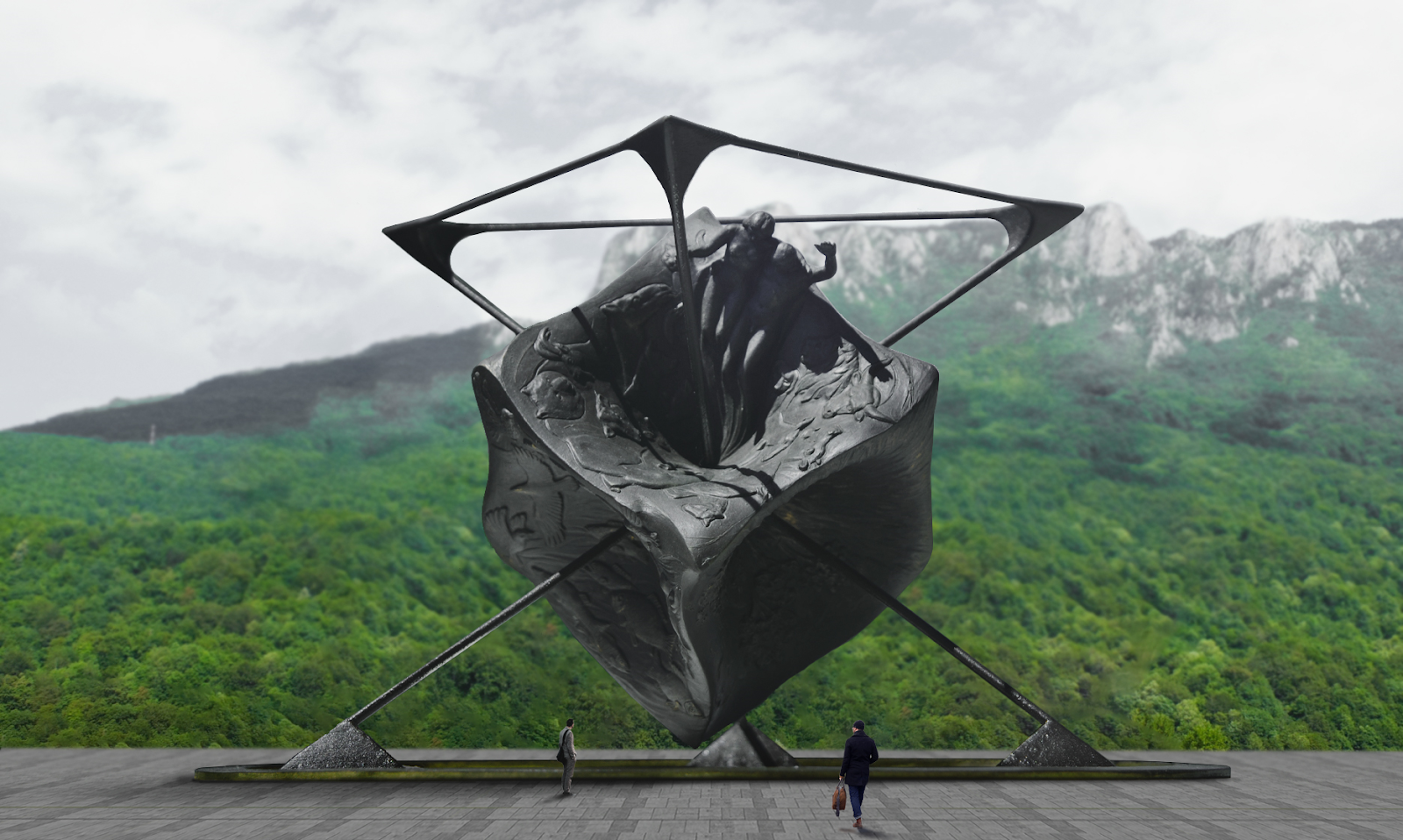
The proposed monument is a complex of symbols and metaphors with a common theme — the creation of the universe. What sort of creation? From a theological perspective, or a scientific one? I would say both. My monument combines both of these, some would say incompatible viewpoints. All religious and scientific elements, symbols and metaphors, exist harmoniously. Each highlights and enhances the other, giving rise to new interpretations, new meanings. It isn’t about any specific view, but rather the connections between them. It is important to note that, regarding creation, science and religion seek to answer different questions — the “how” vs. the “why”. Of course, my monument doesn’t seek to answer these questions, but to visually demonstrate how the various approaches to the subject can be complimentary, rather than oppositional.
The main part of the monument consists of a cube shaped object, simply known as The Cube. It is suspended on three axes passing through its center. The axes form triangles, creating one pyramid above and one below. One corner of The Cube points towards the sky while another points towards the earth The cube is an important element of symbology in all monotheistic religions. The Qaabah in Islam, the tfilin in Judaism (black wooden cubes used for prayer), and a cube unfolded forms a cross, the primary symbol of Christianity. It represents the material world as the circle or sphere represents the spiritual world. In my project it doesn’t symbolize the world itself, but rather it is used to demonstrate the process of its creation. According to the Christian, Judaic, and Islamic beliefs, the world was created in six days. A cube has six sides. In this particular one, the sides are funnel shaped, each one leading back to their common point of origin — the singularity from which the universe came to be, with each side representing one of the six days of creation. All objects are depicted as reliefs, with the exception of man, who is depicted as a three dimensional form, standing above the other elements of creation. The six funnel-shaped sides connect at a common point, the point from which existence as we know it and three dimensional space itself originate. The three axes represent the three dimensions of space. The upper portions go towards the sky, forming an equilateral triangle. The lower portions of the same axes form another one below, giving us two pyramids that also connect in the common point of origin.
Having addressed the religious perspective, let’s discuss the scientific perspective regarding the origin of the universe. Current scientific theories suggest that the universe was created from a singular point of infinite density, as a result of the Big Bang, approximately 13.77 billion years ago. Since that time, the universe keeps expanding, so it can be said that the process of creation is an ongoing one. From that singularity, that common point of origin, matter, energy, three dimensional space, the laws of physics, and space-time itself came to be.The Cube contains that common point of origin. It shows existence expanding out from it, demonstrated by the six funnel shaped sides. It has the three axes of three dimensional space. And, on each of the sides, we see matter, both living and otherwise, being brought into being by the expansion from the singularity. In this way, it is not hard to see how the artistic symbolism I used here is applicable to these differing, and some would say incompatible views of creation.
Finally, there is one more important element that I have not yet mentioned — the triangle inside the circle, which is at the ground level of the monument. In short, the triangle inside the circle represents the material world enclosed in a circle of the infinite. As mentioned previously, the sky or heaven is represented by circular shapes, while the cube represents the earth or material world here.In my project, this circle represents the seventh day, a day of contemplation. A day of physical rest but spiritual labor, of considering what has been created and for what reason. The circle has a path, allowing observers to walk around the monument, symbolically replicating this process. In this way, the observer becomes part of the monument itself for as long as they participate in this. The circle will move up and down using a hydraulic mechanism, allowing the observer to metaphorically travel between the physical and spiritual realms.
Let me conclude by noting that this is meant to be a brief description of my monument. As any work of art worthy of being called that, it will take on its own life, produce its own meanings, and hopefully, observers will be able to find symbolism and meaning beyond that which I consciously included. This is not meant to be an instruction manual for the monument, but an introduction to it, from which real, meaningful dialogue can begin.
Sculptor, Leonid Filitsyan, cell: 201 736 62 63
Email: leonid.filitsyan@gmail.com
Instagram: @sculpture.by.filitsyan
Website: www.leonidfilitsyan.com
WORLD TRADE CENTER

GYPSY MONUMENT


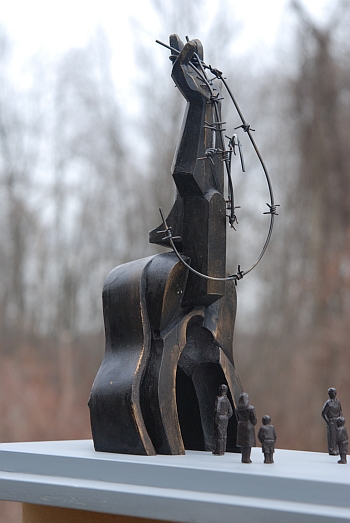

The suggested monument, dedicated to the tragedy of the Romani people, may be called the “Romani Guitar.” The guitar, besides being an exquisite and fascinating musical instrument, is also a universal element of the Romani culture. No matter which Romani – Hungarian, Romanian, Spanish, etc. Their musical culture is associated with the guitar. Moreover, as it appears to me, the guitar is something more than a musical instrument to the Romani. Within the Romani guitar lives the soul of the people. For this reason, through the guitar transformed into a monument, I want to convey the pain and horror of the tragedy.
The body of the guitar is something of an architectural construction resembling a chapel. The resonator opening transforms into an arch. The form of the arch appears as a silhouette, either of a mourning Romani woman, or of the iconic profile of the Divine Mother. This is completely unimportant; each person may form his own associations. The visitors of the monument will pass under the arch. This is a very important moment. Since ancient times, the arch, as well as the column, had a spiritual as well as a functional significance. We know of many examples of freestanding arches and columns. The journey to the monument, and especially the passage through the arch, allows one to readjust internally, to distance oneself from everything fleeting and earthly, to sense the horror and tragedy of the past.
The neck of the guitar-monument – an arm reaching toward the sky. The gesture is very emotional, tragic; it is a scream for help, it is a prayer, it is a stopping gesture, directed at the audience: stop, think, sympathize, immerse yourselves…
The next element – ripped strings – barbed wire wound onto fingers instead of tuning pegs. A small transformation, and the guitar string obtains a completely different meaning, becomes an attribute of the concentration camps, a symbol of slavery. Having passed through the arch and looked back, we see the rear side of the monument, the posterior of the guitar body. It resembles enormous gates that seem to close after us.
We passed through the arch, in our soul and consciousness, we passed through pain, suffering, humiliation along with the victims of genocide. The gates close and there is no way back, there will never be one; I hope, I believe that there will not be.
Note: The small figures are not a part of the monument – they are there to set it to scale.
CLASPED HANDS
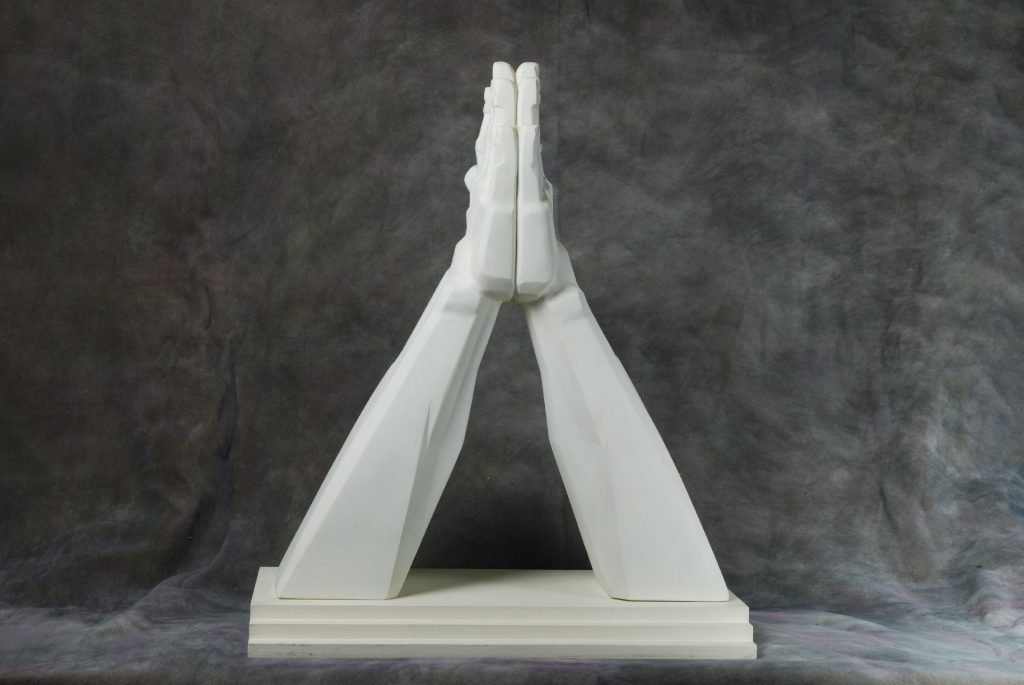
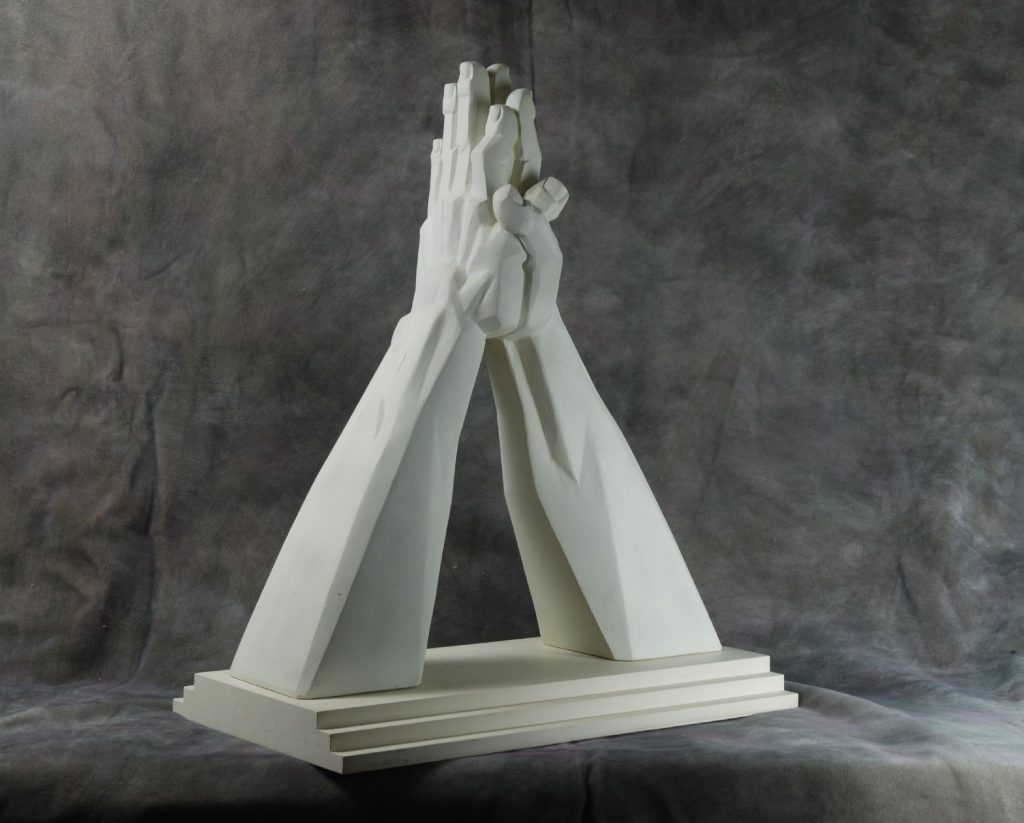
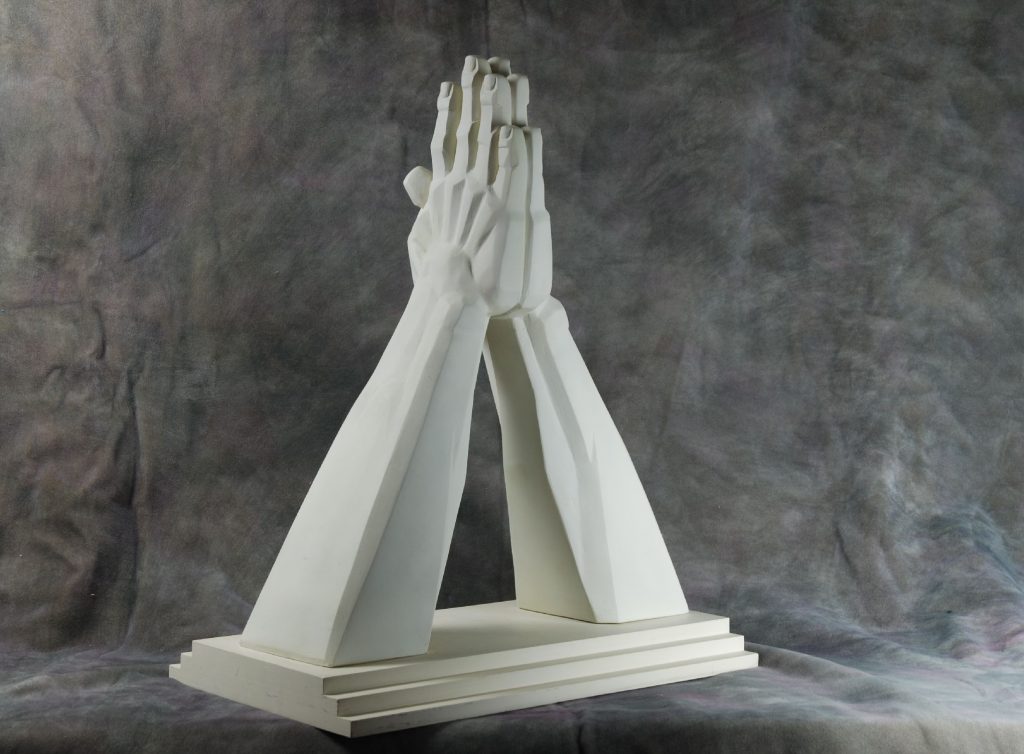
An arch formed by clasped hands; this is one in a series of my sculptural arches. This one was intended to be a part of a tragic monument. Through this arch of hands, as I planned, the visitors can pass to the location of the tragic event. Aside from architectural arches, which are a functional, structural component of a building, we have numerous examples of free-standing arches ( the triumphal arches of Rome, for example), whose function is symbolic. Passing under an arch such as this, a person would experience a sense of spiritual transformation, depending on the idea behind the particular piece of architecture. The idea behind my arch is simple and easy to understand. Hands clasped in prayer, in a sense of grief are recognizable to a person of any religion, or of no religion at all. As we approach the arch we see highly expressive, tensely clasped hands. They act as a sort of a tuning fork of our spiritual state, helping us understand and feel that behind the arch is a different space: a space where time stopped at the moment of tragedy.
ADAM AND EVE
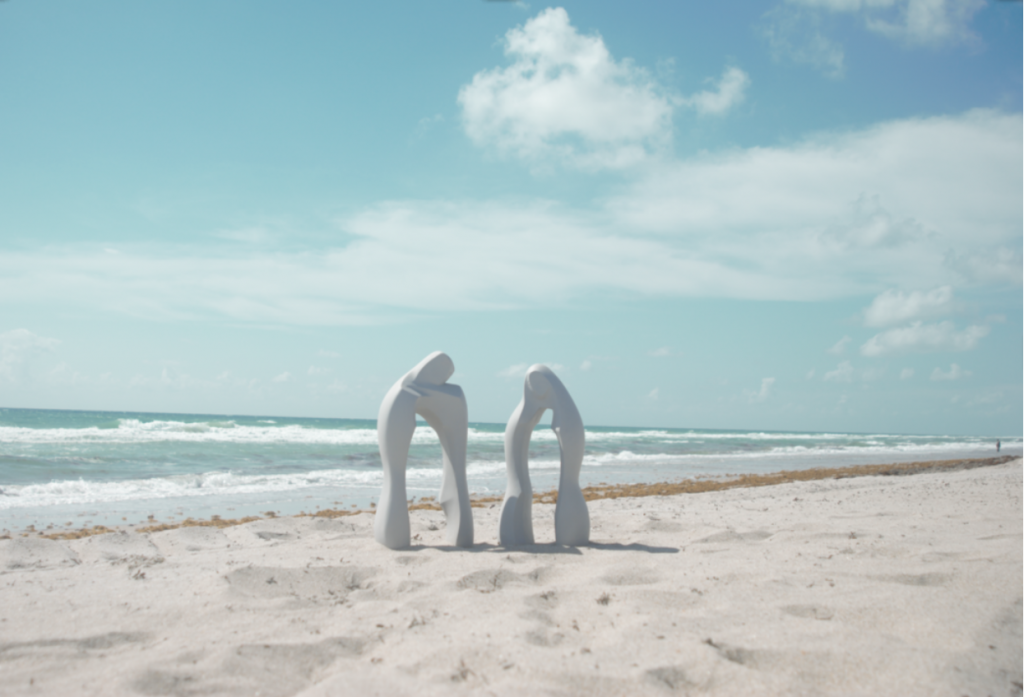
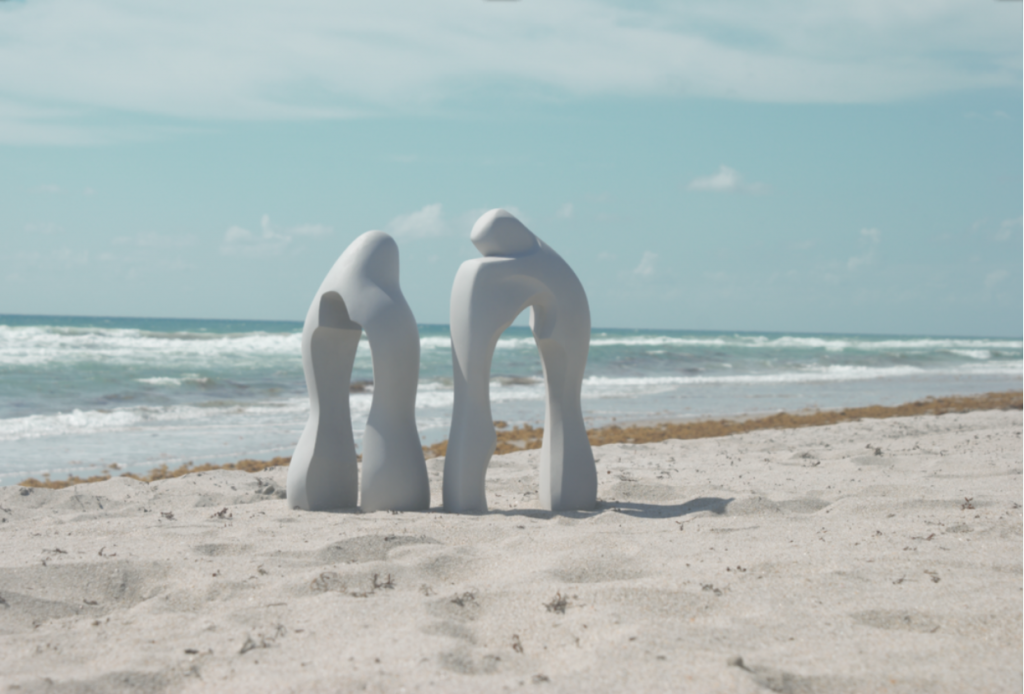
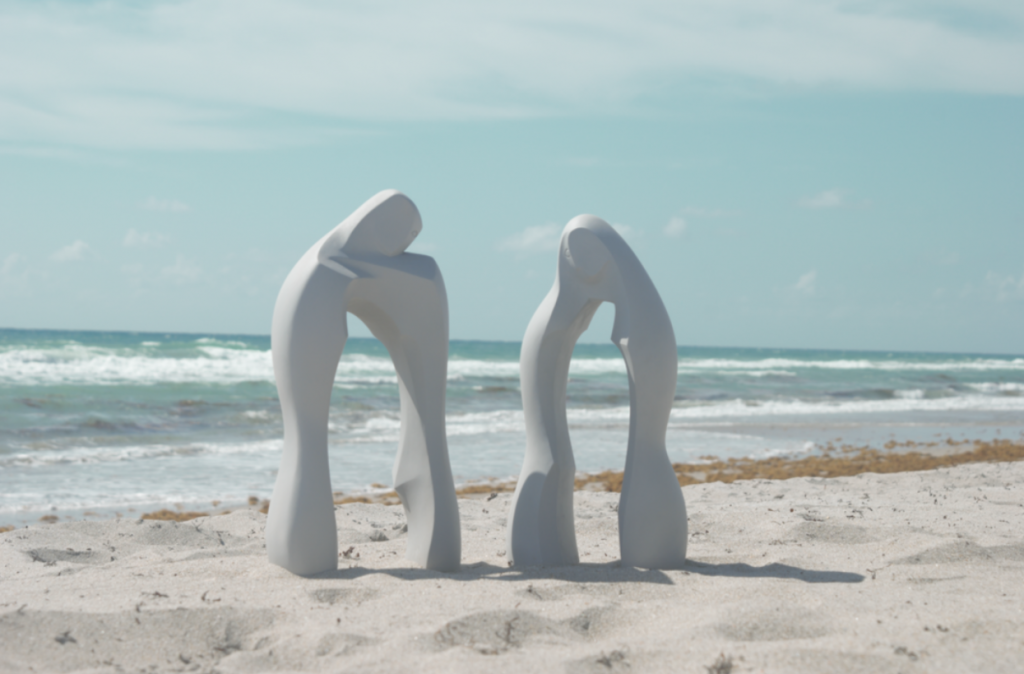
My sculpture “Adam and Eve” isn’t an illustration of the well-known biblical story.
Rather, it’s an attempt to use this story as a means of expression about Man and Woman.
As long as civilization has existed, art has existed as well. And for as long as art exists, artists
have and will continue to use it to discuss the masculine and the feminine. The theme is
constant, never ending, and every time period has its own way of addressing it. I would like to
do the same and add my own expression of it, my own metaphor.
The two sculptures, Adam and Eve, are stylized and abstract. They have no explicitly
anthropomorphic qualities to them, and yet it is obvious which one is which. Separate and
distinct, but two parts of one whole, nevertheless. Without one another, they are devoid of
meaning, of purpose, each being no more than an empty vessel.
In simplest terms, the two sculptures are two arches. In the inner silhouette of the Adam arch we
can see the form of Eve. And in the inner silhouette of the Eve arch we can likewise see the
form of Adam. The immaterial space inside the material arch is the immaterial soul inside the
sculptural body. And so, Adam’s soul is inside Eve and Eve’s soul is inside Adam.
The observer can view these sculptures from the outside at any desired angle. Depending on
the scale, he can also pass through the arch, briefly becoming a part of the artwork. Through his
presence and their mutual interaction, the exhibit becomes something I call “The Lovers’ Arch”.
The act of passing through places the observer in a different spiritual space, a space created of
the ideas that make up this artwork, of my expression of the masculine and the feminine as
parts of a whole. A space where, contrary to all laws of mathematics, 1+1=1